


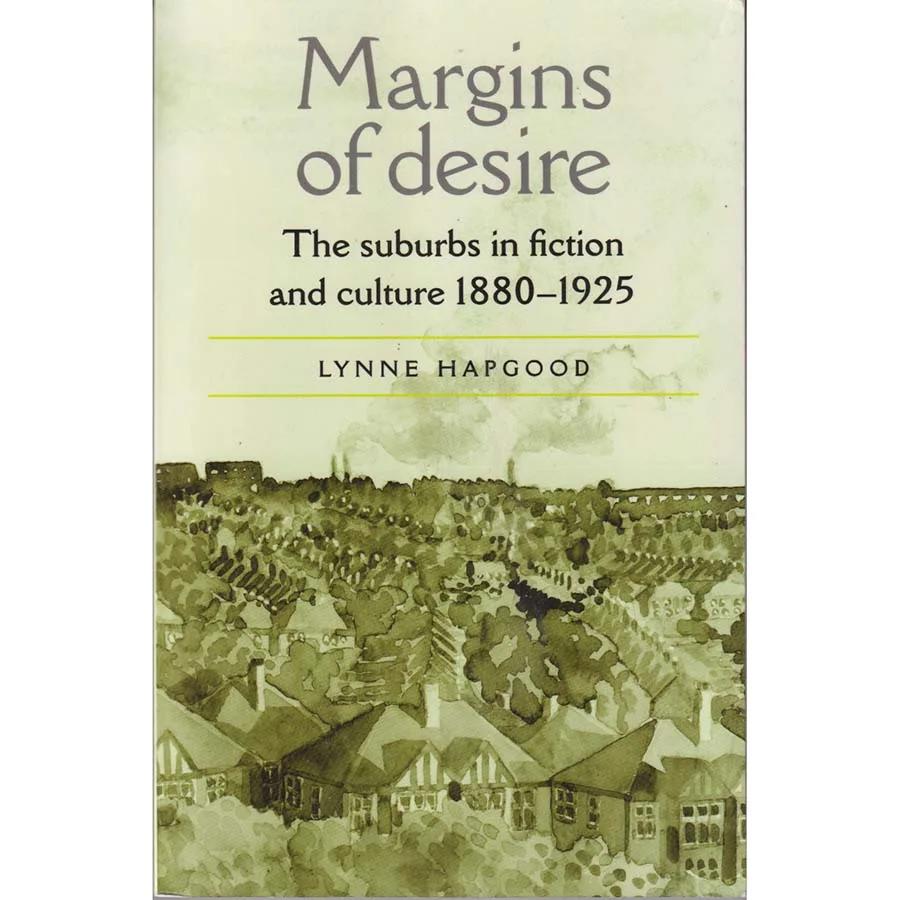
Margins Of Desire - The Suburbs In Fiction And Culture 1880-1925
Publisher: Manchester University Press
Format: Paperback
ISBN: 9780719059711
Welcome to Margins of Desire: The Suburbs in Fiction and Culture 1880–1925 (2005) by Lynne Hapgood — a book that bravely asks the question nobody says out loud at dinner parties: what if the most interesting drama isn’t downtown, but behind a net curtain? Published by Manchester University Press, this is proper academic non-fiction with a clear mission: to take the suburbs seriously, not as a punchline, but as a cultural invention loaded with anxieties, aspirations, and the unsettling power of a well-kept hedge.
This isn’t the suburbs as you see them in estate-agent photos (“family-friendly”, “convenient transport links”, “ample off-street parking”). This is the suburbs as a story machine — a place where modernity gets tested, identities get rehearsed, and desire has to squeeze itself into polite shapes. Between 1880 and 1925, suburbia becomes a space that promises safety and respectability while quietly generating the very tensions it claims to solve: class mobility, gender roles, privacy, consumption, propriety, boredom, ambition, and the fear that you might become… comfortable.
Hapgood digs into how suburban life shows up in fiction and wider culture, where it often carries a weird double charge: it’s meant to be the “nice” option, yet it’s also portrayed as suspiciously performative. The street is orderly, the interiors are curated, the neighbours are watching, and the self you present to the world is always one awkward moment away from being revealed as an act. If you’ve ever felt that the suburbs are simultaneously soothing and faintly uncanny — congratulations, this book is basically your diagnosis, with footnotes.
Expect discussions of suburban space as symbolism, of domesticity as social theatre, and of the cultural forces that created the suburb as a modern ideal and a modern worry. It’s the kind of study that makes you see a semi-detached house and think, ah yes, a micro-stage for late Victorian anxieties and early twentieth-century reinvention. Which is not a normal thought, but it’s a better one.
Condition: Good, meaning it’s sturdy and readable — a used academic title with enough life left to sit on your desk looking intelligent, or to be smugly displayed on a shelf as proof that you don’t just live near the suburbs, you can also theorise them. There may be mild signs of handling, but nothing that will stop it doing its main job: making you look at ordinary streets and realise they were never culturally neutral.
Perfect for readers who like:
-
literary and cultural studies with a sharp eye,
-
the history of everyday spaces,
-
early modern Britain’s social nervous system,
-
and the delicious realisation that “quiet” places are often where the loudest meanings hide.
Sold by Crappy Old Books, naturally — because where else would a serious, slightly sinister study of suburban desire end up, if not somewhere wonderfully unglamorous, waiting for the next curious mind to discover that the margins are where the action is.
Keep browsing: See more Academic books Other books by Lynne Hapgood
